

Classification of metal forging
20
2024.8
Author
502
Read volume
Forging is a common metal working process that plastically deforms the metal under pressure applied by a forging machine to form a forging with the appropriate shape and size. During the forging process, the metal blank is forged multiple times, and the internal microstructure is optimized and the mechanical properties are improved.
Forging can be divided into hot forging, warm forging and cold forging according to the processing temperature.
The hot forging processing temperature is higher than the recrystallization temperature of steel, above 800 ℃. Such a high temperature is conducive to optimizing the as-cast structure of steel, refining the grains, and improving the mechanical properties of steel. It is the preferred method for forging workpieces in most industries; The warm forging temperature is between 300 ℃ and 800 ℃. This processing process can improve the quality and accuracy of forgings and is generally used for forging precision forgings; Cold forging is generally carried out at room temperature and can replace some cutting processing. Warm forging and cold forging are usually used to process forging parts such as automobiles and general machinery, which is the development direction of future die forging.
According to the classification of forming mechanism, forging can be divided into free forging, die forging and special forging.
Free forging adopts hot forging, which can be divided into machine free forging and manual free forging. It uses impact force or pressure to freely change the shape of the forgings without restriction, and is suitable for producing forgings with small batches.
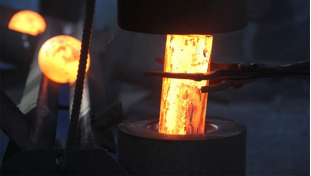
There are three forms of die forging: hot forging, warm forging and cold forging. During forging, the metal blank is deformed by pressure in a forging die cavity with a certain shape and is formed. This forging method has extremely high material utilization rate, but attention needs to be paid to control the volume of the blank to avoid wear of the forging die. It is generally suitable for the production of light weight and large batch forgings.
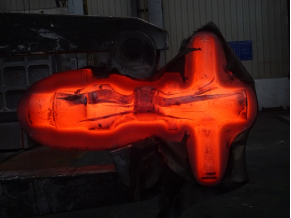
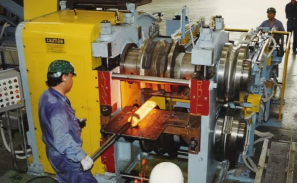
There are many forging forms of special forging, such as roll forging, radial forging or liquid forging, etc., which are usually used for forgings with special shapes. For example, roll forging is used for pre-forming of forgings to reduce subsequent forming pressure; radial forging can be used for forming large forgings; liquid forging dies can directly prepare forgings such as metal-matrix composite pipes and rods.


Online Selection

1V1 Customer Service