

Classification and installation of internally threaded inserts
20
2024.8
Author
912
Read volume
Inlays refer to metal, rubber, fiber, glass or formed plastic parts embedded in plastic. They serve to add the function of plastic parts or are used as decoration, usually fasteners or supports. Most fastener inserts are threaded inserts, which can be divided into external thread inserts and internal thread inserts. This article mainly introduces internal thread inserts, that is, insert nuts. Internal thread inserts can be divided into copper nuts (C3604brass or lead-free copper), stainless steel nuts (SUS303), carbon steel nuts (12L14or12L15) and aluminum nuts according to their materials. Due to the good thermal conductivity of copper and easy processing, copper nuts are most used in actual products, so copper internal thread inserts are mainly introduced below.
Copper nuts can be divided into: hot melt type/ultrasonic type, in-mold injection type, press-in type and expansion type according to the embedding method, that is, installation method.
The hot melt typeis the most common embedding method. When a hot melt machine is used to heat the nut to the softening temperature of the plastic, the nut is embedded in the plastic, the pressure head is withdrawn, and the nut and the plastic are melted into one after the temperature cools.
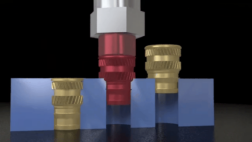
The principle of the ultrasonic type is very similar to that of the hot melt type, but the heating method is different. Ultrasonic vibration is used to cause the friction between the inner molecules of the nut and the surrounding plastic surface to generate heat. When the temperature rises to the softening temperature of the plastic, the nut is buried inside the plastic., the vibration stops, and the workpiece is cooled and formed under a certain pressure.
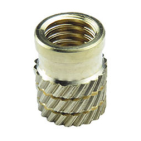
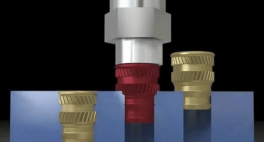
Since the principles and processes of the above two methods are similar, the front end of the nut has a guide structure, so the types can be classified into one category. The reserved holes of the plastic parts can also be universally used, but the material of the nut is different. Because the hot melt type directly heats the nut and requires the nut to have good thermal conductivity, so we usually choose copper as the raw material; the ultrasonic type does not need to limit the nut material, and can be used either stainless steel or carbon steel.
The in-mold injection molding type is to place the nut into the mold, and then the rubber compound will wrap the nut during injection molding, and it will be formed after cooling. This embedding method has the best bonding strength of the molded part, but since placing the nut will affect the injection molding cycle time, the time cost is greatly increased; and the nut placement position also needs to be very precise, otherwise it may affect the quality of the molded part. Or damage the mold and increase production costs.
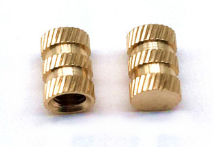
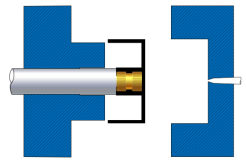
Press-in type mainly refers to pressing nuts directly into plastic at room temperature. This type is mainly for plastic parts that cannot be hot pressed, such as thermosetting plastic that cannot be softened again after curing and molding.

The principles of the expansion type and the press-in type are similar, but the expansion nut has grooves on the side, which can elastically deform when cold-pressing and embedding the plastic part. After screwing in the screw, the side walls of the expansion nut open outward and form "biting" contact with the inner wall of the hole.
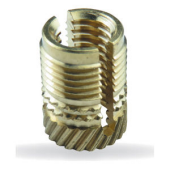
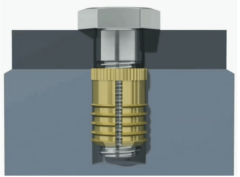
The above two cold-pressed nuts are cost-effective and easy to install, but their performance is not as good as the previous hot-pressed nuts. They can be selected according to the main needs of customers when selecting models.
(图源网络)
技术支持:郭洪华
编辑:刘康利


Online Selection

1V1 Customer Service